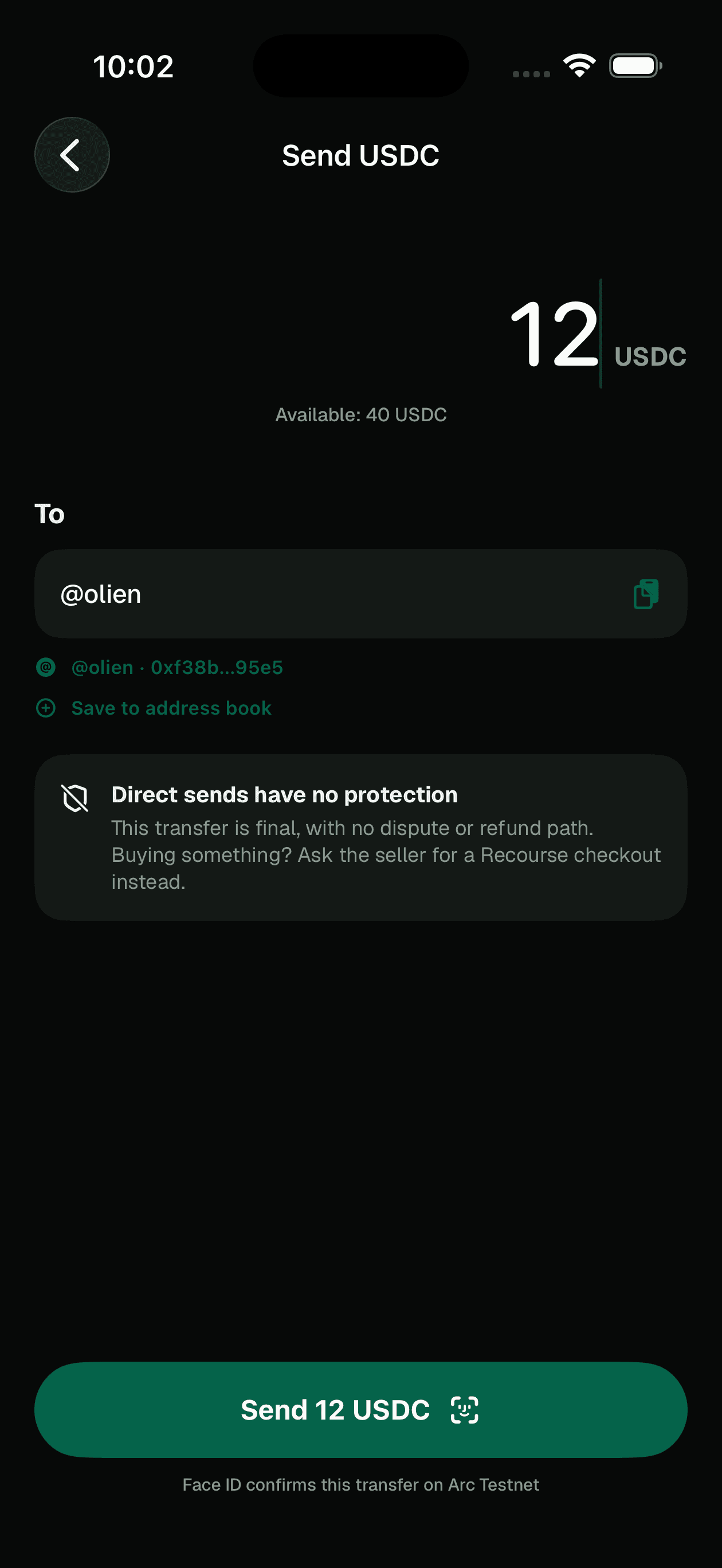
Escrow USDC under immutable refund rules. Buyers get verifiable recourse, merchants get paid immediately, and disputes resolve from evidence instead of opinion.
Refund policies are locked in before payment and cannot be changed later.
Learn moreDisputes resolve based on rules and verified evidence, not human opinion.
See how it worksMerchants get paid immediately. We handle the protection behind the scenes.
For merchantsEscrowed funds earn yield through USYC during the dispute window.
Explore the vaultRecourse separates objective evidence from the final outcome. Humans and services can attest to facts, while immutable policy code decides what those facts mean.
The merchant publishes clear refund rules onchain. Every payment stores the exact policy hash, so the terms cannot change later.
Protected funds move into a yield adapter during the dispute window instead of sitting idle in a basic escrow contract.
The policy engine evaluates claim type, evidence, timing, and objective attestations. The first matching rule sets the refund.
Merchants can receive a T+0 advance from the vault while buyers retain the full protection window attached to their payment.
The public verifier reads live Arc state and runs the same deterministic policy rules in two independent environments.
0x683e3c325e6e...bc650fOnchain0x683e3c325e6e...bc650fTypeScriptBuyers keep recourse, merchants keep velocity, and liquidity providers can see the exact risk they are underwriting.
Read the refund policy in plain language, submit evidence when something goes wrong, and verify the result independently.
Accept protected USDC payments, publish reusable policies, and use the settlement vault to receive funds immediately.
Vault liquidity advances merchants against escrow claims and earns fees plus float yield while refund exposure stays policy-bounded.
The settlement vault advances enrolled merchants against protected escrow claims. Liquidity providers earn the advance fee and float yield, then absorb any policy-defined refund loss.
See vault mechanicsRecourse is intentionally narrow: immutable policies, deterministic outcomes, productive escrow, and transparent settlement risk.
The onchain policy engine computes the outcome from the policy and submitted inputs. An attestor may confirm objective facts such as delivery status, but it cannot choose the refund percentage.
No. Policies are immutable. A merchant can publish a new version for future payments, but an existing payment remains pinned to the original policy hash.
The escrow deposits USDC into a yield adapter during the protection window. The current Arc testnet deployment uses the project’s mock USYC-compatible adapter until production access is available.
The public verifier reads the payment and policy from Arc, computes the verdict in the browser, calls the Solidity preview function, and confirms that both verdict hashes match exactly.
No. This is a testnet prototype for the hackathon. The contracts, attestation model, yield integration, and operational controls require production audits and hardening before mainnet use.
Explore the dashboard, inspect a seeded payment, and change the evidence inputs yourself.